Phototherapy Equipment Lifecycle: From Installation to Replacement
Most clinics treat phototherapy equipment like a plug-and-play appliance. Reality works differently. These systems need careful management from delivery through eventual replacement. Understanding the phototherapy equipment lifecycle means better treatment outcomes, controlled expenses, and fewer surprises when equipment shows its age.
Whether you’re bringing in your first unit or replacing an aging system, knowing what happens at each phase, from phototherapy equipment installation through lamp replacement cycles, helps you avoid expensive mistakes.
Installation & Initial Setup Phase
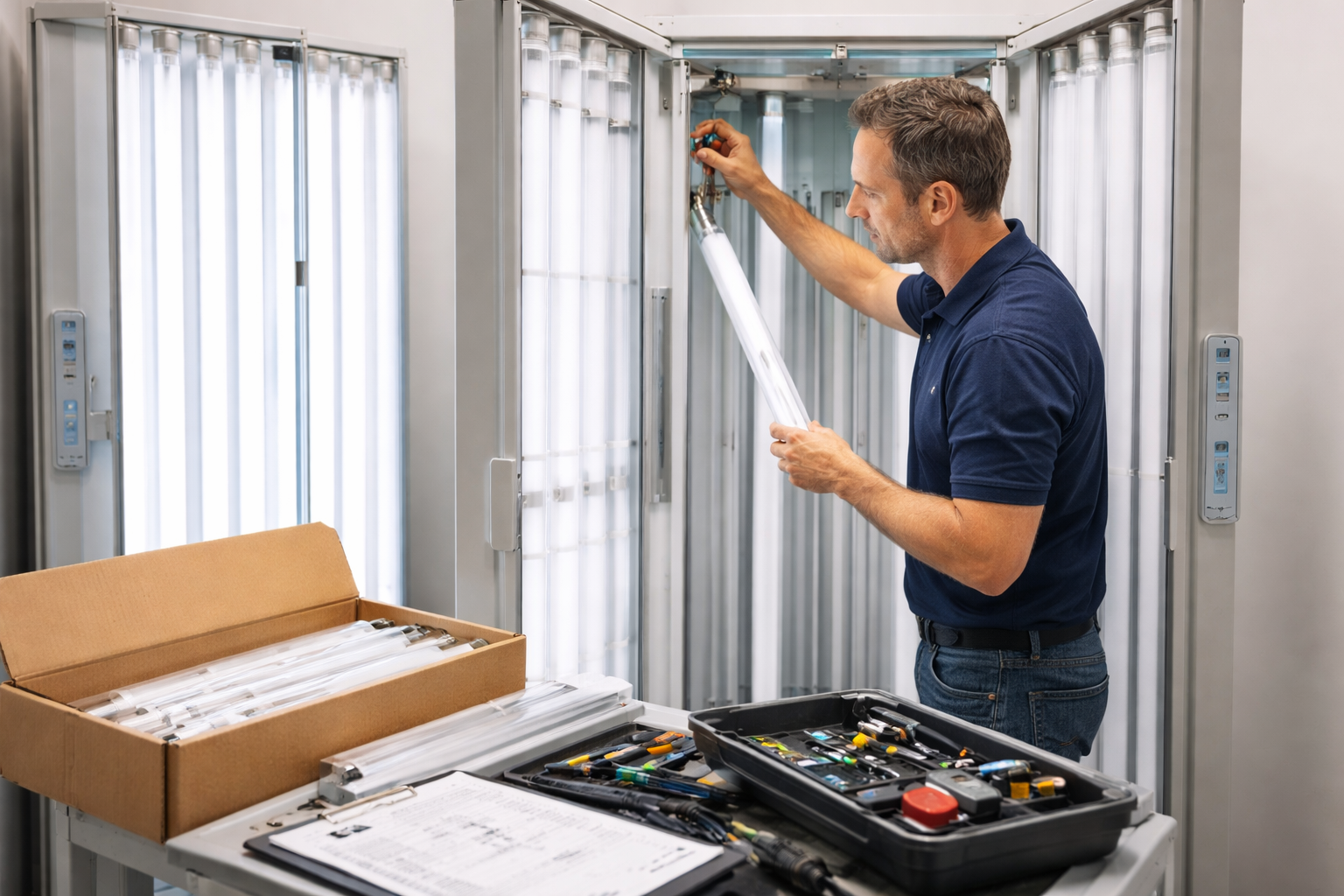
Your phototherapy equipment lifecycle starts before installation day. Certified technicians handle setup, they verify electrical connections, test grounding for safety codes, and confirm power supply stability to prevent component damage (1).
During phototherapy equipment installation, technicians take baseline irradiance readings using calibrated UV radiometers. These measurements become your reference point for tracking lamp output degradation over time. They measure across the treatment area, documenting high points, low points, and average output.
Safety testing covers timer accuracy (treatments rely on precise exposure duration), emergency stops, and interlock switches on enclosed units. For Phototherapy Room Setup, ventilation becomes critical, UV systems generate heat requiring adequate airflow (2).
Staff orientation before first treatments covers operation, troubleshooting, and safety protocols including eye protection, patient positioning, and documentation procedures.
Operational Lifespan of Systems
Medical phototherapy equipment lifespan typically hits 10 years, though cabinets often outlast internal component performance.
Patient volume drives longevity. A clinic treating five patients daily experiences different stress than one running 20+ sessions. Usage hours count more than calendar age — a lightly-used eight-year-old system can outperform a heavily-worked four-year-old unit (3).
Environmental factors matter. Hot, humid climates accelerate degradation. Dust reduces lamp efficiency and stresses cooling systems. Technical specs call for maintaining treatment rooms at 10-40°C with 30-90% relative humidity (1).
Structural durability and performance lifespan differ. Your cabinet might look perfect after 12 years, but if components can’t maintain therapeutic output, appearance doesn’t help patients. Tracking performance data throughout the phototherapy equipment lifecycle becomes essential for replacement planning.
Lamp Replacement Cycles
UVB lamp lifespan creates the most predictable maintenance expense you’ll face.
Narrowband UVB lamps fade gradually. Mercury inside depletes as heat activates UV production. Over 9,000-10,000 operating hours, output drops to 70-80% of specifications (4). The lamp keeps producing visible light, creating a false sense everything works fine. But UVB lamp output degradation directly impacts treatment effectiveness.
Replacement timing depends on actual usage:
Heavy daily use (8+ hours): Every 3-6 months
Moderate use (4-6 hours daily): Every 6-9 months
Light use (2-3 hours daily): Once yearly
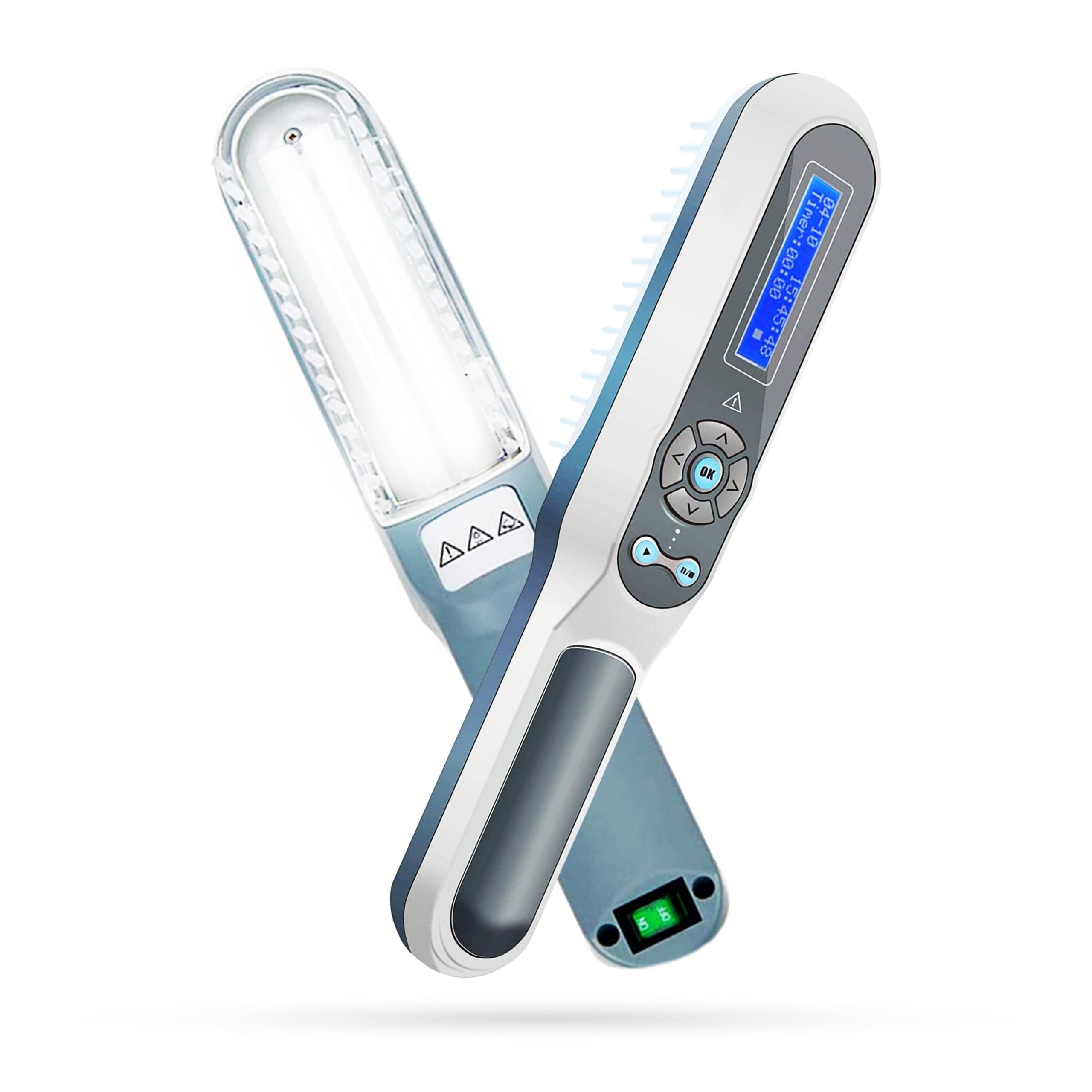
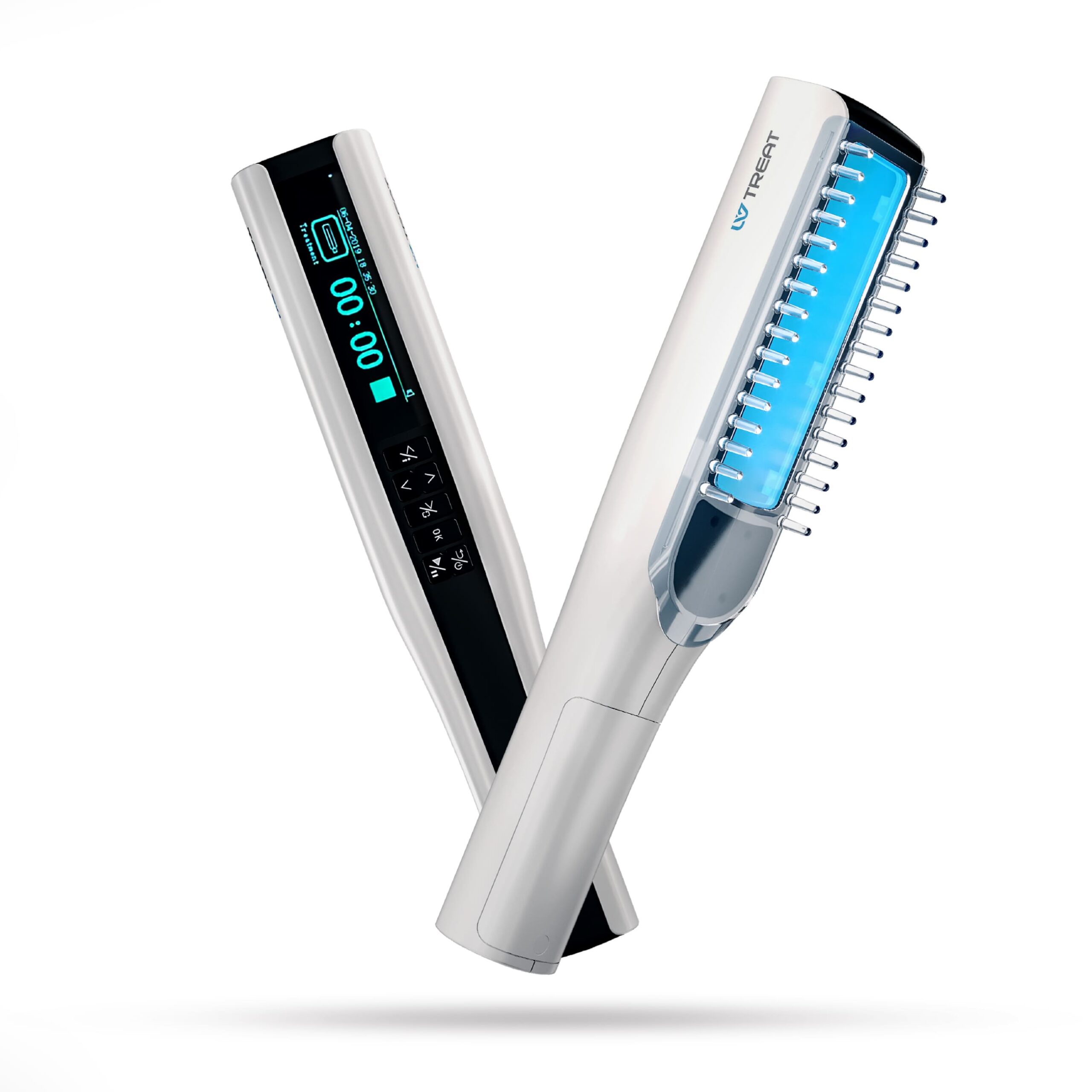
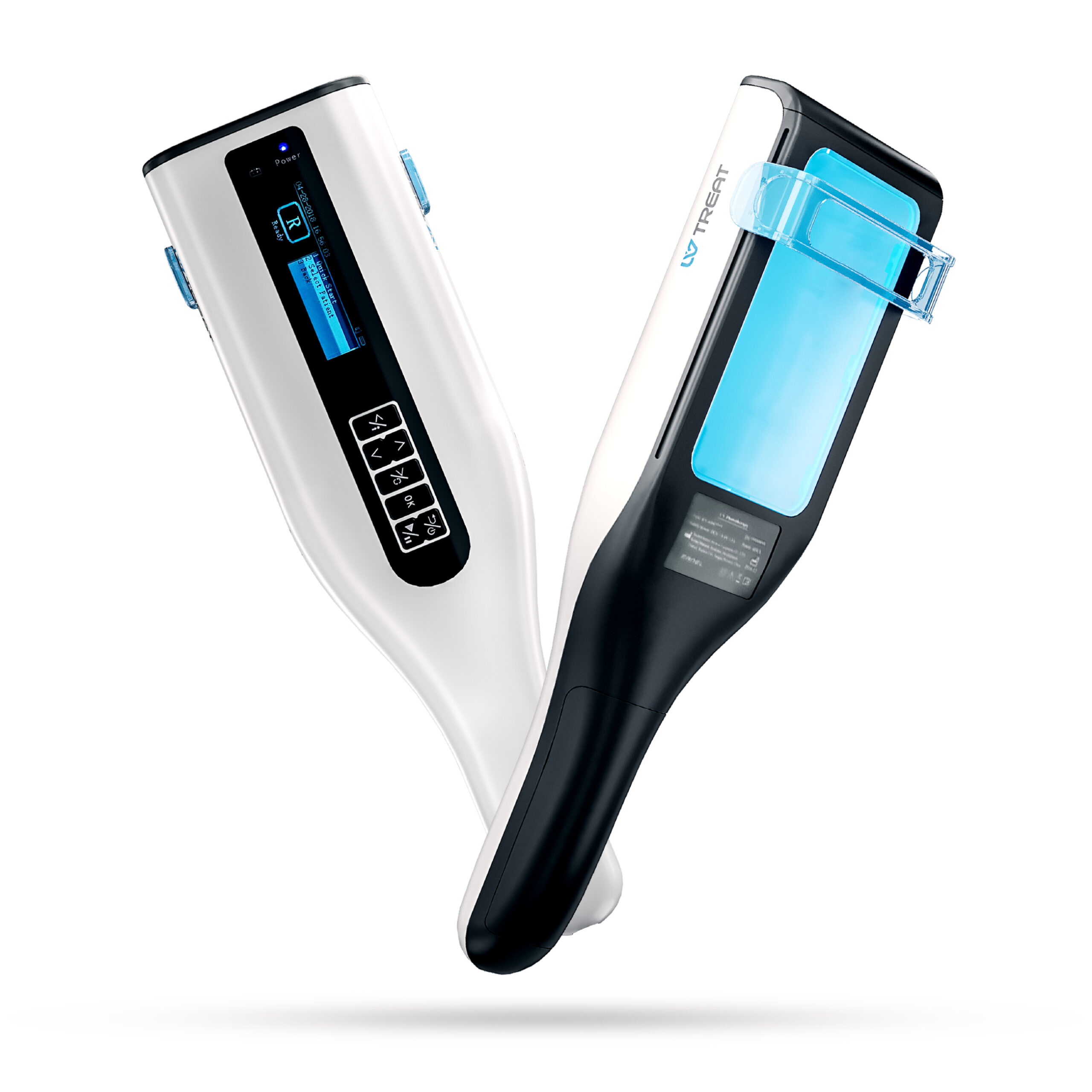
Most modern UVB phototherapy devices track cumulative operating time with built-in hour meters. Some alert automatically when lamps approach replacement thresholds (5). Without these features, maintain manual logs to calculate when you’ve hit that 9,000-hour mark.
Performance testing confirms replacement timing. Regular irradiance measurements show degradation trends. When output falls below therapeutic thresholds, treatment times increase, your signal that phototherapy lamp replacement can’t wait (4).
Budget $500-2,000 for complete lamp replacement depending on system size.
Preventive Maintenance Planning
Structured phototherapy system servicing prevents most unexpected failures that shut down schedules.
Daily maintenance takes five minutes: wipe surfaces with approved disinfectants, check power connections, verify basic controls. Weekly tasks need more attention, clean filters and fans, inspect cords for wear, test emergency stops. For facilities implementing Clinical Safety Audits, weekly checks document ongoing safety verification (6).
Monthly inspections go deeper. UV lamps get cleaned with manufacturer-approved cleaners. Cabinet interiors and reflective surfaces need inspection. Any performance changes get documented.
Quarterly professional service becomes necessary for high-volume clinics, comprehensive irradiance testing, filter replacement, detailed performance verification. Lower-volume facilities sometimes extend to twice yearly, but annual professional maintenance represents the bare minimum (3).
Annual service contracts typically cost 5-15% of equipment value. This covers scheduled preventive maintenance phototherapy systems require, plus priority service response. Most contracts bundle parts discounts and unlimited service calls.
Documentation serves multiple purposes. Compliance audits need proof of regular servicing. Warranty claims require maintenance records. Historical performance data helps equipment replacement decisions.
Performance Monitoring & Output Testing
Treatment accuracy depends on knowing exactly how much UV light reaches patients. You can’t assume, you measure.
UV radiometers measure irradiance (light intensity at specific distances). Different wavelength bands need different meters. Narrowband UVB systems at 311nm need meters calibrated specifically for that wavelength (7). Using wrong or uncalibrated meters gives false confidence about treatment delivery.
Annual calibration against traceable national standards keeps measurements accurate. Medical physics departments offer calibration services. Calibration certificates stay on file for compliance (7).
Standardize measurement protocols. Measure at consistent distances after letting lamps warm up 15-20 minutes. Record environmental conditions, temperature and humidity affect readings. Document lamp hours at each measurement.
For full-body systems, measure at multiple points. Designated patient irradiance (DPI) requires readings at 12 body locations ensuring uniform coverage (7).
Build schedules matching usage intensity. High-volume clinics: weekly spot checks plus monthly full mapping. Lower-volume facilities: monthly spot checks with quarterly comprehensive testing.
Documentation goes beyond numbers. Track equipment serial numbers, radiometer calibration dates, technician names, any anomalies. This data supports quality assurance and provides evidence of due diligence.
Upgrade vs Replacement Decisions
Equipment doesn’t have to reach the end of medical phototherapy equipment lifespan before replacement makes sense. Sometimes upgrading early delivers better outcomes than nursing aging equipment to failure.
Technology advancement represents one upgrade trigger. LED systems offer 25,000+ hour lamp life versus traditional 9,000-hour fluorescent tubes. Energy consumption drops 60-80% (8). These benefits can justify early replacement when current equipment still functions.
Component upgrades work when cabinet structure stays solid but internal systems need refreshing. Replacing ballasts, control systems, or converting to LED extends life at 20-30% of new equipment cost when parts remain available (3).
Full phototherapy system upgrades become necessary when repair costs approach 70-80% of replacement value, vendor support disappears, or equipment can’t meet current safety standards. For clinics Scaling Phototherapy Programs, capacity constraints drive replacement before end-of-life, one aging unit can’t serve expanding patient demand.
Your decision framework weighs multiple factors. Patient safety takes priority. Performance degradation extending treatment times signals replacement time. Vendor support availability matters, equipment becomes obsolete when parts aren’t available.
Financial analysis must consider the total cost of ownership, not just purchase price. New systems with higher upfront cost but lower operating expenses often deliver superior 10-year value.
Budgeting Lifecycle Costs
Smart financial planning accounts for every phase, not just initial purchase price.
Capital costs vary wildly. Basic portable units start around $2,000-3,000. Clinical full-body cabinets run $10,000-25,000. Advanced systems reach $25,000-50,000+ (9). Refurbished equipment offers 20-30% savings but demands careful quality vetting.
Ongoing expenses accumulate steadily. Annual maintenance contracts cost 5-15% of equipment value ($1,000-3,000 yearly for clinical systems). Lamp replacement every 3-6 years adds $500-2,000. Energy costs depend on technology, LED systems use dramatically less.
Total cost of ownership over 10 years typically runs 2-3 times purchase price. A $15,000 system might cost $35,000-45,000 across its lifecycle (9). This perspective justifies spending more upfront for quality equipment reducing long-term costs.
Set aside 10-15% of equipment value annually for replacement reserves. This prevents budget shock when replacement arrives.
Funding options include equipment financing (3-7 year terms), operating leases (lower monthly cost but higher total), and short-term rentals. Most clinical systems pay for themselves within 2-5 years through patient service revenue (9), justifying the lifecycle investment.
Managing the phototherapy equipment lifecycle effectively demands attention to every phase from installation through replacement. Facilities that invest in proper setup, maintain rigorous servicing schedules, monitor performance consistently, and plan replacement strategically maximize both clinical outcomes and return on investment. Your phototherapy system represents a decade-long commitmen, plan accordingly and track diligently.
Share
References
UNICEF Supply Division. (2023). Phototherapy unit, LED, overhead, mobile. Technical specifications for medical equipment. https://supply.unicef.org/s0002032.html
Nature Scientific Reports. (2023). Cost-effectiveness of home phototherapy for hyperbilirubinemia in neonates. Economic analysis of phototherapy equipment. https://www.nature.com/articles/s41598-023-37684-y
FAQ
Replace UVB lamps based on operating hours, not calendar time. Standard interval is every 9,000-10,000 operating hours (4). Heavy daily use (8+ hours) means replacement every 3-6 months. Moderate use (4-6 hours daily) requires replacement every 6-9 months. Light use (2-3 hours daily) needs annual replacement. Always measure lamp output with calibrated UV radiometers—lamps appear to work normally while UV output has degraded below therapeutic levels. Replace when output drops to 70-80% of original specifications.
Lamp output is measured using specialized UV radiometers calibrated for specific wavelength bands (7). Place the meter at standard treatment distance (typically 20-40 cm) after allowing lamps to warm up 15-20 minutes. Measurements are recorded in µW/cm²/nm or mW/cm². For full-body systems, measure at 12 body positions ensuring uniform coverage. The radiometer requires annual calibration against national standards. Keep detailed records including date, equipment serial numbers, lamp hours, and environmental conditions.
Phototherapy equipment maintenance follows tiered schedules: daily surface cleaning and safety checks; weekly filter cleaning, cord inspection, and emergency feature testing (6); monthly lamp cleaning, performance checks, and detailed inspections; quarterly professional irradiance testing and filter replacement for high-volume clinics. Annual maintenance by certified technicians must include comprehensive calibration, electrical safety testing, radiation output verification, and compliance documentation (3). Annual service contracts typically cost 5-15% of equipment value.
Consider upgrades when equipment reaches 70-80% of expected 10-year lifespan, when repair costs approach 70-80% of replacement value, or when annual maintenance exceeds 15% of replacement cost (3). Technology advances may justify earlier replacement—LED systems offer 25,000+ hour lamp life and 60-80% energy savings (8). Replace immediately if equipment can't meet current safety standards, if vendor support becomes unavailable, or if clinical performance degrades despite proper maintenance. Component upgrades make sense when costs run under 30% of new equipment. Full replacement becomes necessary when age, rising costs, performance issues, and clinical requirements converge.
To provide the best experiences, we use technologies like cookies to store and/or access device information. Consenting to these technologies will allow us to process data such as browsing behavior or unique IDs on this site. Not consenting or withdrawing consent, may adversely affect certain features and functions.
Functional
Always active
The technical storage or access is strictly necessary for the legitimate purpose of enabling the use of a specific service explicitly requested by the subscriber or user, or for the sole purpose of carrying out the transmission of a communication over an electronic communications network.
Preferences
The technical storage or access is necessary for the legitimate purpose of storing preferences that are not requested by the subscriber or user.
Statistics
The technical storage or access that is used exclusively for statistical purposes.The technical storage or access that is used exclusively for anonymous statistical purposes. Without a subpoena, voluntary compliance on the part of your Internet Service Provider, or additional records from a third party, information stored or retrieved for this purpose alone cannot usually be used to identify you.
Marketing
The technical storage or access is required to create user profiles to send advertising, or to track the user on a website or across several websites for similar marketing purposes.