UVB Panels and Cabinets





Info
UVB phototherapy remains one of the longest-validated treatment modalities in dermatology, and the equipment used to deliver it in the clinic falls into two practical categories: panels and cabinets. Both systems emit ultraviolet B radiation in the narrowband range of 311–313 nm, the wavelength accepted as the dermatological standard for inflammatory and pigmentary skin disorders (1, 2).
These devices are used in dermatology clinics, hospital phototherapy units, university dermatology departments, and specialized vitiligo and psoriasis centers. They also fit well in multidisciplinary medical facilities where physicians combine UV phototherapy with adjunct light-based modalities such as photodynamic therapy and photobiomodulation.
A clinic’s choice depends on the type of disease being treated. Targeted devices and compact panels work for localized lesions – palmoplantar psoriasis, segmental vitiligo, scalp involvement. Full-body cabinets, by contrast, treat generalized disease in a single short exposure and support higher session volumes (3, 4). Many established phototherapy practices run both formats in parallel, since each format addresses a clinical need the other cannot.
We will review the differences between panel and cabinet systems, the operational factors that should guide equipment selection, and where modern UVB platforms fit alongside complementary technologies such as red light and infrared therapy panels in a contemporary clinical setting.
UVB Panels vs Full-Body Cabinet Systems
The structural difference between the two formats drives nearly every operational characteristic that matters in clinical practice.
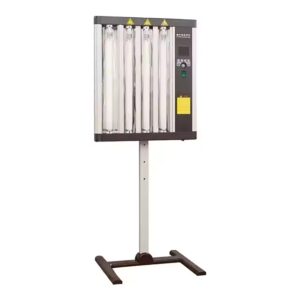
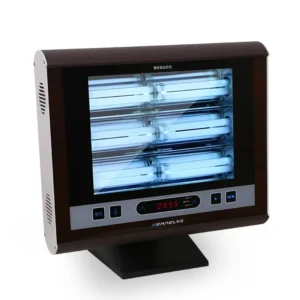
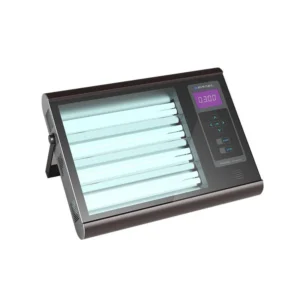
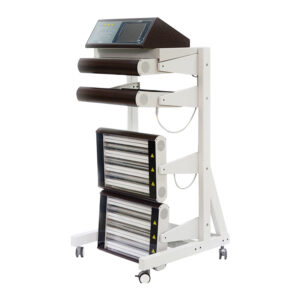
A UVB panel emits light from a flat or folding fixture on one side of the patient. Lamp counts typically range from one to ten. Compact 311 nm panels equipped with two to six Philips PL-S or PL-9 narrowband bulbs cover irradiation areas between 500 and 1,500 cm² (5). These devices are well suited for localized psoriatic plaques, palmoplantar disease, segmental vitiligo, and follow-up maintenance therapy. Larger half-cabin panels with four 100 W lamps extend coverage without requiring a full enclosure.
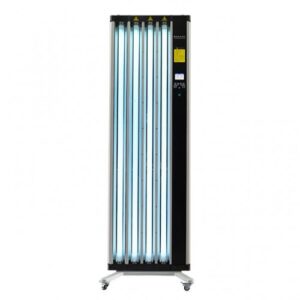
A full-body cabinet is a multi-sided walk-in unit. The reference Kernel KN-4001 measures 1230 × 1230 × 2173 mm and houses 40 Philips medical-grade lamps of 100 W each, delivering an irradiation area of approximately 49,000 cm² (6). Comparable units carry 24–28 lamps with similar coverage geometry (7). Cabinets are designed for whole-body exposure in a single positioning.
Workflow efficiency
Cabinet treatment times are short. Sub-erythemogenic NB-UVB doses are typically delivered in 30 seconds to 4 minutes, depending on protocol and skin type (8). Joint AAD–NPF guidelines recommend NB-UVB sessions two to three times per week, with thrice-weekly dosing producing clearance in a mean of 58 days versus 88 days for twice-weekly schedules (3).
Panel sessions take longer because the patient must reposition between exposures to cover front, back, and sides. For a clinic running 90 sessions per week, this difference is operationally meaningful: a cabinet at five minutes per session manages this volume in approximately 7.5 hours of device time, while a single-side light therapy panel at 20 minutes per session requires roughly 30 hours.
Treatment coverage
Whole-body disease – generalized psoriasis with greater than 10–20% BSA, generalized vitiligo, mycosis fungoides, widespread atopic dermatitis – is more efficiently addressed in a cabinet. Localized presentations such as palmoplantar pustulosis, scalp psoriasis, segmental vitiligo, or isolated plaques are appropriate indications for a panel or handheld targeted device (3, 9).
For adults with localized plaque psoriasis, AAD–NPF guidelines recommend targeted UVB at 2–3 sessions per week, with dose initiation based on either minimal erythema dose (MED) or skin phototype protocol (3).
Clinic setup
Cabinets require a dedicated treatment room with adequate ventilation, sufficient ceiling clearance, and an electrical service capable of supporting a 5500 VA load (6). Manufacturer documentation specifies a dedicated junction box with a safety disconnect switch (10). Daavlin’s installation manual confirms that domestic 100/120 V models require a grounded three-prong outlet rated for at least 15 A, while higher-power configurations require dedicated wiring installed to local code (10).
Panels run on standard wall outlets, fit into a smaller treatment bay of approximately one square meter, and require no specialized ventilation. This makes them practical in clinics where space and electrical infrastructure are limited.
Choosing the Right Light Therapy System for a Clinic
Selecting phototherapy equipment is a five-to-ten-year capital decision. Lamps will be replaced multiple times over the device’s service life, so the initial choice should be based on how the system fits the clinic’s clinical caseload and physical environment, rather than on consumables.
Treatment area and patient population. Audit the patient panel before specifying equipment. The proportion of candidates with widespread disease versus localized disease determines the panel-to-cabinet allocation. A vitiligo-focused practice with a high segmental case rate may benefit more from a 308 nm targeted excimer system combined with several 311 nm panels than from a single full-body cabinet. A general dermatology practice with a steady psoriasis caseload usually justifies a cabinet on first-month utilization.
Available space and electrical infrastructure. Cabinet floor area is roughly 1.5 m², plus operator clearance and ventilation requirements. UV lamps generate heat that must be dissipated. The Kernel KN-4001 incorporates three ventilators and bottom extractor fans for thermal management (6). Electrical capacity must be verified against unit specifications before installation; Daavlin guidance is explicit that the junction box must be installed before the unit arrives (10).
Patient volume and throughput. A clinic running fewer than ten phototherapy sessions per week may find a panel system more economical, since a cabinet at low utilization underuses its capacity. Above approximately fifteen sessions per week with substantial whole-body involvement, cabinet capital expenditure typically pays back through faster session times and lower per-patient staff time.
Portability and modularity. Multi-location practices and hospital phototherapy services that visit inpatient wards benefit from wheeled panel systems. Some platforms – for example the Solarc SolRx E-Series – start as two-bulb panels and expand into multi-directional wrap-around configurations as clinic volume grows (11). This is a relevant option for clinics that want to enter phototherapy gradually.
Operational and regulatory needs. Devices marketed for prescription use in the United States require FDA clearance. In the European Union, MDR/CE marking is the equivalent benchmark. Practices billing third-party payers should confirm that the chosen system supports MED testing, dose-tracking exports, integrated dosimetry, and EMR-compatible logs. The Daavlin Integrated Dosimetry controller, for example, measures lamp output and calculates exact treatment time from the prescribed dose in mJ/cm² (10). These features support documentation requirements for CPT 96910 (supervised photochemotherapy with tar and/or UVB), which is the most commonly used code for full-body NB-UVB cabinet sessions, and CPT 96900 for unsupervised or localized UV treatment (12).
Benefits of Modern UVB and LED Therapy Systems
Phototherapy hardware has changed substantially over the past two decades. Modern systems integrate dose control, workflow features, and multi-spectrum flexibility that were not standard on earlier equipment.
Controlled exposure
The clinical value of NB-UVB at 311–313 nm lies in selective immunomodulation: the wavelength is sufficient to drive apoptosis of pathological T cells in inflamed skin while limiting exposure to the broader, more mutagenic UV range (1, 2). Modern controllers preserve this safety margin through precise dosing.
Built-in dosimeters, automatic dose escalation per AAD protocols, and backup safety timers protect against overexposure. Integrated dosimetry systems calculate treatment time based on real-time lamp output rather than assumed fluence, which compensates for the natural decline in fluorescent tube output over the lamp lifecycle (10). For maintenance therapy after clearance, AAD–NPF guidance specifies a 25% dose reduction held constant across maintenance sessions – a calculation that programmable controllers handle automatically (3).
Workflow integration
Modern cabinets and panels include touchscreen controls, patient-specific protocol recall, and EMR integration. The Kernel KN-4001 stores up to 100 treatment records per patient across 9,999 patients, with quick recall by medical record number (6). Some platforms support direct integration with Epic and EMA systems, simplifying prescribing and documentation in higher-volume practices (4).
Adherence is a measurable clinical outcome. The 783-patient LITE trial demonstrated that home phototherapy systems running guided-mode protocols achieved approximately three-fold higher adherence than ad-hoc dosing (4). Interface design directly affects patient compliance and therefore treatment efficacy.
Flexibility across protocols
Multi-spectrum cabinets allow a single device to support several treatment modalities. Independent or simultaneous activation of UVA and NB-UVB lamp banks lets one piece of equipment cover NB-UVB for psoriasis and atopic dermatitis, UVA1 for morphea and scleroderma, and PUVA for refractory cases (1). This reduces capital requirements for clinics serving a varied referral base.
Patient population suitability
NB-UVB is recognized as a first-line option for patient groups in whom systemic therapy is contraindicated or undesirable. AAD guidance supports its use during pregnancy, in pediatric patients, in elderly patients, and in immunocompromised individuals (3, 13). A pediatric psoriasis study (n = 88, mean age 12 ± 4 years) reported a 75% improvement at a mean treatment duration of 3.1 ± 2.26 months, with full clearance achieved in 51% of cases (13). A meta-analysis of NB-UVB for psoriasis in skin of color found PASI 75 achieved in 70.5% of patients across nine studies (14).
Adjunct LED and infrared modalities
A growing number of clinics integrate UVB phototherapy with photobiomodulation platforms, including red light LED panels emitting at 630–670 nm and infrared light therapy panels at 830–850 nm. The two modalities act through different biological mechanisms: NB-UVB drives immunomodulation in inflamed skin, while a red light LED panel or infrared panel drives photobiomodulation through cytochrome c oxidase activation and increased mitochondrial ATP production (15, 16).
The clinical evidence base for photobiomodulation is strongest in androgenetic alopecia, where a meta-analysis of seven sham-controlled randomized trials of FDA-cleared home-use devices showed a statistically significant increase in hair count (15). Evidence for acne supports red and blue LED combinations as adjuncts, though a comparative trial found NB-UVB outperformed 630 nm red light on acne lesion count and global severity score (17).
For clinics building a multimodal suite, a full body red light therapy panel or RLT panel installed in the same space as a UVB cabinet broadens the service offering. A portable LED panel can support ambulatory sessions across multiple rooms. An infrared light panel may be useful as an adjunct for patients who report post-UVB dryness, where near-infrared has been studied for barrier support (16). These devices do not replace UVB; they address different therapeutic targets.
Lamp longevity
LED-based 311 nm panels report a service life four to six times longer than traditional fluorescent UV tubes, reducing long-term consumables expenditure (5). On fluorescent platforms, all lamps in a cabinet should be replaced together to avoid uneven dose delivery (10).
Explore Professional UVB Panels and Cabinets
UVTREAT supplies the full Kernel Medical Equipment phototherapy portfolio to clinics, hospitals, and dermatology distributors. The catalog spans the clinical use cases described above – compact tabletop 311 nm devices, handheld 308 nm targeted systems, stand-mounted half-cabin panels, and four-sided 40-lamp full-body cabinets such as the KN-4001 with combined NB-UVB and UVA configurations (6).
For clinics building a multimodal phototherapy suite, the portfolio also includes LED photodynamic therapy systems for acne, actinic keratosis, and skin rejuvenation; LED beds for full-body photobiomodulation protocols; and replacement UVB lamps, including Philips medical-grade narrowband bulbs compatible with most professional phototherapy units in clinical use today.
Each Kernel system is supplied with applicable FDA clearance documentation, operator manuals, treatment protocol references, and warranty support. UVTREAT works directly with clinic owners and procurement teams to specify configurations matched to patient mix, room layout, and budget. Equipment leasing options and a B2B rental program are available for practices that prefer to evaluate a system before committing to purchase.
For technical datasheets, configuration quotes, or in-person product walkthroughs, contact the UVTREAT team. Product demonstrations can also be arranged at industry events, including the AAD Annual Meeting.
References
- de Moura Barros N, Sbroglio LL, Buffara MO, et al. Phototherapy. An Bras Dermatol. 2021;96(4):397–407. https://www.ncbi.nlm.nih.gov/pmc/articles/PMC8245715/
- Bandow GD, Koo JY. Narrow-band ultraviolet B radiation: a review of the current literature. In: Phototherapy. StatPearls Publishing; 2023. https://www.ncbi.nlm.nih.gov/books/NBK563140/
- Elmets CA, Lim HW, Stoff B, et al. Joint American Academy of Dermatology–National Psoriasis Foundation guidelines of care for the management and treatment of psoriasis with phototherapy. J Am Acad Dermatol. 2019;81(3):775–804. https://www.jaad.org/article/S0190-9622(19)30637-1/fulltext
- Phothera. Phototherapy for vitiligo, psoriasis, eczema and CTCL: clinical evidence and platform features. https://www.phothera.com/
- Kernel Medical Equipment Co., Ltd. KN-4006B1 narrowband UVB phototherapy lamp specifications. https://uvtreat.com/product/kn-4002b1-narrow-band-uvb-311nm-phototherapy-panel-2-2/
- Kernel Medical Equipment Co., Ltd. KN-4001 UVB phototherapy cabinet specifications. https://www.kernelmedint.com/product/uvb-phototherapy-cabinet-equipment-for-vitiligo-kn-4001
- Skin Matters Bristol. 24-lamp narrowband phototherapy unit, Philips TL 100W/01 311 nm specifications. https://www.skinmattersbristol.com/product/24-lamp-narrowband-phototherapy-unit-fitted-with-24-x-6ft-philips-tl-100w-01-uvb-17-narrowband-lamps-311-nm/
- University Hospitals Sussex NHS Foundation Trust. Narrowband ultraviolet B (NB-UVB) phototherapy treatment information. https://www.uhsussex.nhs.uk/resources/narrowband-ultraviolet-b-radiation-nb-uvb-phototherapy-treatment-for-your-skin-condition/
- Almutawa F, Alnomair N, Wang Y, Hamzavi I, Lim HW. Systematic review of UV-based therapy for psoriasis. Am J Clin Dermatol. 2013;14(2):87–109. (Referenced in AAD–NPF guidelines, citation 3.)
- Daavlin Distributing Co. ClearLink UV Series clinical operation manual: installation, electrical requirements, and dosimetry. https://daavlin.com/wp-content/uploads/2024/01/MNL-00008-5-ClearLink-Clinical-Operation-Manual-min.pdf
- Solarc Systems Inc. SolRx E-Series full body phototherapy system: modular configuration. https://solarcsystems.com/solrx-e-series-full-body-phototherapy-system/
- Bonfire Revenue. Phototherapy billing: CPT 96900, 96910, 96912 – coding and documentation requirements. https://www.bonfirerevenue.com/phototherapy-billing-cpt-96900-96910-96912/
- Pavlovsky M, Baum S, Shpiro D, Pavlovsky L, Pavlotsky F. Narrow band UVB: is it effective and safe for paediatric psoriasis and atopic dermatitis? J Eur Acad Dermatol Venereol. 2011;25(6):727–729. (Referenced in pediatric phototherapy review, citation source: https://www.ncbi.nlm.nih.gov/pmc/articles/PMC9864074/)
- Kim WB, Marinas JE, Qiang J, Shahbaz A, Greaves S, Yeung J. Narrowband ultraviolet B phototherapy for psoriasis treatment in skin of color: a systematic review and meta-analysis. J Cutan Med Surg. 2025. https://www.ncbi.nlm.nih.gov/pmc/articles/PMC12411661/
- Chopra S, Morrissette K, Fan E, Hendren S, Pavlis M. Photobiomodulation and photodynamic therapy using red LED light in dermatology: a narrative review. Bratisl Med J. 2025;126(9):2041–2053. https://scholars.duke.edu/individual/pub1683616
- Glass GE. Photobiomodulation: a review of the molecular evidence for low-level light therapy. J Plast Reconstr Aesthet Surg. 2021. (Referenced in photobiomodulation comprehensive review: https://www.mdpi.com/1422-0067/25/8/4483)
- Wong T, Hsu L, Liao W. Phototherapy in psoriasis: a review of mechanisms of action – comparative data on NB-UVB versus 630 nm red light for acne. (Referenced in: https://pmc.ncbi.nlm.nih.gov/articles/PMC11049838/)
- Eleftheriadou V, Thomas K, Ravenscroft J, Whitton M, Batchelor J, Williams H. Feasibility, double-blind, randomised, placebo-controlled, multi-centre trial of hand-held NB-UVB phototherapy for the treatment of vitiligo at home (HI-Light trial). Trials. 2014;15:51. https://www.ncbi.nlm.nih.gov/pmc/articles/PMC3923442/
FAQ
- A UVB panel treats from one side and is mainly used for localized areas such as the scalp, hands, feet, or smaller lesions. UVB cabinets surround the patient with lamps for full-body treatment in short sessions. Cabinets are better for high patient volume, while panels require less space and lower installation costs.
- Yes. UVB panels are widely used in clinics for localized conditions, maintenance therapy, and patients who prefer open treatment systems. Many clinics use both cabinets and panels together depending on patient needs and treatment volume.
- Key factors include patient type, available space, electrical setup, expected treatment volume, and regulatory requirements. Smaller clinics often start with a panel system and expand later as demand grows.
- Yes. Many clinics combine NB-UVB treatment with red or near-infrared LED therapy. UVB is used for inflammatory skin conditions, while red light therapy supports recovery and skin wellness through different biological mechanisms. These treatments are usually performed in separate sessions.