UVB Lamp Bulbs
Info
Every clinical phototherapy system depends on a UVB light source, and that source is the bulb. UVB lamp bulbs emit ultraviolet B radiation between 280 and 315 nm – the part of the spectrum that does the therapeutic work on the skin (1). In professional cabinets, panels, and handheld units, the bulbs take the form of low-pressure fluorescent tubes made for medical use (4). Their output doesn’t last forever. As a lamp ages, its intensity falls and dosing gets harder to control, so clinics replace bulbs before that point (3). UVTREAT supplies UVB phototherapy bulbs and replacement lamps to clinics, hospitals, and dermatology practices across the U.S. and Latin America. Our focus is Philips lamps – the ones that drop straight into the phototherapy equipment clinics are already running.
UVB Lamp Bulbs Used in Clinical Phototherapy
During a session, a UVB bulb puts a measured dose of ultraviolet light onto the skin. That energy lands mostly in the upper epidermis, where it breaks the runaway cell turnover and settles the immune activity behind chronic skin disease (1).
These days most clinics reach for narrow band UVB bulbs rather than the older broadband lamps. Narrowband output sits close to 311 nm – the wavelength that clears skin best and burns the least, since broadband tubes also throw off shorter, more irritating wavelengths (1)(2). That tight therapeutic window is why nb uvb bulbs became standard, and the story starts with the Philips TL/01 lamp, which brought 311 nm treatment into routine clinical use (2).
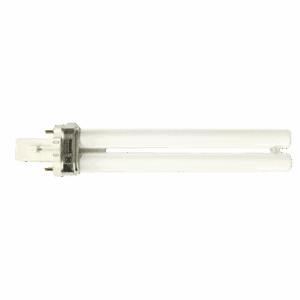
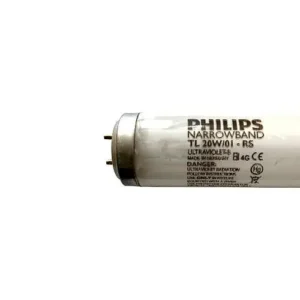
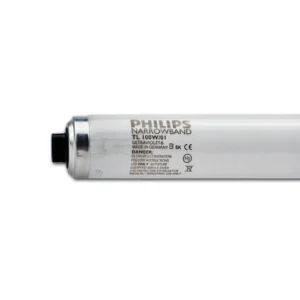
In practice, the bulbs are uvb fluorescent bulbs in a tube shape. Philips produces lamps which most equipment is designed around: the six-foot TL 100W/01 goes into full-body cabinets, the TL 20W/01 and TL 40W/01 fit smaller panels, and the short PL-S tubes handle scalp and handheld devices (3,4). Broadband versions (the /12 series) still exist for specific protocols, but narrowband dominates everyday clinical work.
On the clinical side, uvb phototherapy bulbs treat psoriasis, eczema (atopic dermatitis), and vitiligo, along with early-stage cutaneous lymphoma, persistent itch, and polymorphic light eruption (1)(2). For psoriasis and eczema, narrowband UVB is a first-line phototherapy choice; in vitiligo, it’s a proven route to repigmentation (2). Our guide to phototherapy for psoriasis covers the protocols and outcomes in more detail.
How Clinics Choose UVB Replacement Bulbs
Selecting uvb replacement bulbs starts with compatibility. The lamp model, base type, length, and wattage all have to match the device exactly – a Philips TL 100W/01 with an R17d base is not interchangeable with a G13 bi-pin tube, even if both are narrowband (3). Installing the wrong bulb can throw off the calibrated dose or fail to fit at all.
Performance consistency is the next priority. UVB lamp bulbs fade with use. They lose strength gradually, long before they ever stop lighting (3). Two lamps with identical ratings won’t always age in step either, so clinics change the whole set at once rather than replacing tubes one at a time – that keeps the light even across the treatment field and the dose where it should be (2). Reliability comes from the same place: a genuine, professional-grade lamp holds its irradiance session after session, and accurate dosing and patient safety depend on exactly that (2).
This is also why sourcing matters. Phototherapy units are regulated medical devices, and the bulbs are a working component of that system. UVTREAT provides genuine Philips uvb phototherapy bulbs and replacement solutions for professional clinical use, helping clinics keep their equipment performing to specification. For smaller or targeted setups, we also supply compatible options for a uvb handheld light.
Final Thoughts
Reliable UVB bulbs are what keep phototherapy consistent. When the lamps hold their output and match the device precisely, clinics can deliver accurate doses, predictable results, and safe treatment over the full course of care. Choosing quality narrowband UVB replacement bulbs and replacing them on schedule is one of the simplest ways to protect both clinical performance and patient outcomes.
References
(1) DermNet. UVB phototherapy. https://dermnetnz.org/topics/uvb-phototherapy
(2) British Association of Dermatologists and British Photodermatology Group guidelines for narrowband ultraviolet B phototherapy 2022. British Journal of Dermatology, 2022;187(3):295–308. https://academic.oup.com/bjd/article/187/3/295/6966564
(3) Philips (Signify). UV-B Narrowband TL 100W/01 SLV/10 – product datasheet. https://www.signify.com/global/prof/special-lamps/various-uv-applications/uv-b/philips-uv-b-narrowband-tl/928034900130_EU/product
(4) Philips Lighting. UVB Narrowband lamps. https://www.mea.lighting.philips.com/application-areas/specialist-applications/special-lighting/various-uvb-applications/uvb-narrowband
FAQ
- They power medical phototherapy. The UVB light is dosed onto the skin to calm conditions like psoriasis, eczema, and vitiligo, slowing overactive cell growth and easing inflammation (1).
- Narrowband bulbs put out a thin band near 311 nm - the wavelength that treats best and burns least. Broadband bulbs cover a wider range that includes harsher short wavelengths, which is why clinics have largely moved to narrowband (1)(2).
- A few hundred to roughly a thousand hours is typical, depending on the lamp and how hard it runs (1). Since intensity fades slowly, the real cue is a radiometer reading: once output drops well below the original, relamp (3).
- Match the bulb to the device - same model, base, length, and wattage - change the whole set at once, and stick to genuine professional-grade lamps so dosing stays accurate (2)(3).